

Do Alternative Investments Belong In Your Portfolio?
What are “Alternative Investments”?
Why invest in alternatives?
Some of the primary arguments for including alternative assets in a portfolio are:
- Larger opportunity set for return potential: there are many more privately owned companies than publicly traded ones. Private equity increases the number of companies that investors can access. In recent years, companies have delayed IPOs and stayed private for longer. Private equity makes those early stage companies available for investment.
- Higher yields than on publicly traded income holdings: the private debt market can deliver higher interest rates to investors than publicly traded bonds do.
- Lower volatility / diversification of exposure: alternative investments are theoretically less likely to experience value changes in lockstep with the public markets, giving investors a less volatile portion of the portfolio to balance out the traditional stocks and bonds.
Why not?
Some of the primary arguments against including alternative assets in a portfolio are:
- They are expensive. The expenses involved in managing these investments are high, and the managers often take a large portion of the profits.
- They are not very liquid. The counterpoint to the low-volatility argument above is that if there is a market downturn in the public markets, your alternative investment may not give you much relief since you may not be able to sell it or exit the investment when you need to. Many of the funds are multi-year commitments, and even the ones that offer liquidity at intervals can suspend their redemption programs if the investment is not performing well or many investors are trying to exit.
- The returns can vary widely and it is common to hear that “manager selection is critical”– meaning that some managers will deliver excess returns and others will not.
The final point above is one of the most important reasons why we at Together Planning do not generally recommend alternative investments to our clients. This slide was part of a presentation from a 2020 conference for fee-only fiduciary financial advisors and it gave us pause:
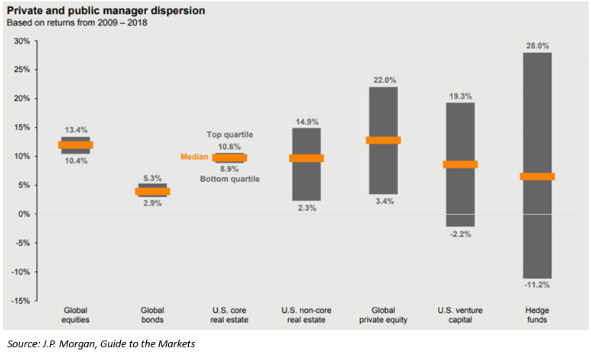
The presentation, which was titled “Is the 60/40 portfolio dead? Why alternatives are important in a low return world” was meant to argue for including alternatives in more client portfolios in the face of potentially lower stock and bond returns in the forecast period. Instead it left us feeling uninspired. In the slide image above, notice that the median return for equities is higher than the median return for all other asset classes, including alternatives. Some of the alternatives did have (much) higher returns than the highest equity returns, but they also had (much) lower returns. In order to have a chance at those higher returns, you must accept an equal chance of disappointing returns, along with high expenses and limited liquidity.
The wide range of potential returns, importance of manager selection, high expenses and low liquidity of these alternative investments have led us to opt against recommending them to our clients. On the other hand, we know that some clients have an appetite for something a little different in the portfolio along with traditional stock and bond funds. We are revisiting alternative investments overall and the menu of alternative investment funds that are available through our custodian’s platform.
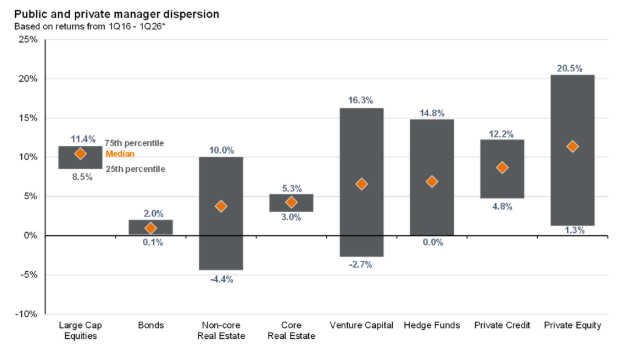
As we prepared this article, we looked for an updated version of that slide from the 2020 presentation. Here it is:
Source: J.P. Morgan Asset Management
Over the last ten years, large cap equities have still done just as well as private equity in terms of median returns, with a much tighter range of returns. A new category on the 2026 version of the chart is Private Credit. We will discuss these funds more below.
Private Equity
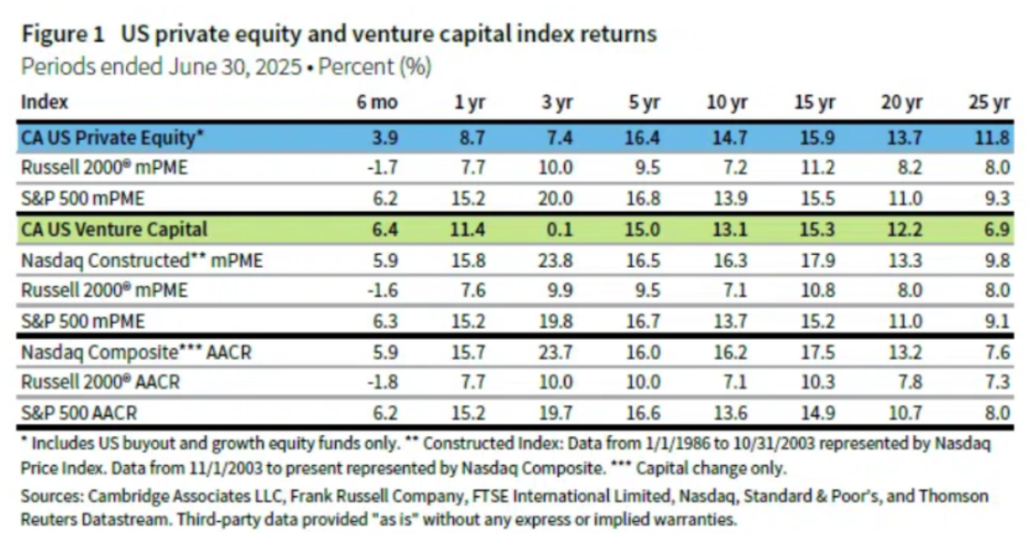
In order to see meaningfully higher returns in private equity and venture capital, you need a longer historical period– 20 years according to this chart:
https://www.cambridgeassociates.com/insight/us-pe-vc-benchmark-commentary-first-half-2025/
Of the 24 private equity funds available on the platform available to our clients at Schwab, five have a history of at least seven years, which is the typical cycle of a private equity investment. These five funds had average annualized 5-year returns of 9.9% and median of 10.6%. This compares to 10.7% for US stocks for the period. We identified two with relatively attractive returns. If you are interested in learning more about those, let us know and we can share the information.
We are not recommending an investment in these funds, but for those who want exposure to private equity, these might be attractive choices.
Private Credit
Private Credit funds grew quickly after 2020 when banks pulled back on credit during the Covid-19 related economic slowdown. Private credit funds make loans to small and middle-market companies. Investors receive income from the fund that is generated from interest payments made on the loans. These are higher risk investments than publicly traded bonds and core bond funds, probably higher than high-yield bond funds, but the returns may justify the risk for some investors.
The reported loan losses in these funds are actually lower than for leveraged loans and high yield bonds over the past five years, but the reporting could be slightly misleading. Issuers of private credit are able to re-negotiate loan terms if a covenant (financial benchmark) is missed by the borrower. In addition, many of the borrowers are companies owned by private equity sponsors, who often step in with additional capital to service the loan if they believe in the company as a good long-term investment.
Of the 20 private credit funds available on the Schwab platform, three have a history of at least five years. Those three funds had average annualized 5-year returns of 8.4% and median of 8.25%. This compares to 3.98% for high-yield bonds for the period.
One observation when reviewing these private credit funds is that some have heavy lending exposure to software companies without hard assets to offer as collateral. With rapid changes occurring in the technology sector, this should be considered as a potential risk.
As with the Private Equity funds above, we are not recommending an investment in these funds, but for those who want exposure to private credit, these might be attractive choices to make up 1-10% of a fixed income portfolio. If you are interested in learning more about these funds, let us know and we can share the information.
Other Ways to Diversify Your Portfolio
Our philosophy is that using low-cost diversified index funds will provide all the diversification you need in a portfolio of any size. With exposure to the entire equities market and the bond market in an appropriate allocation, you are positioned well for long-term growth. However, we know that many investors like to have exposure to something a little different in their portfolio. If you are looking to invest a bit in something other than stock and bond funds, but don’t want to use the alternative assets we have discussed here, there are some publicly traded securities that may appeal to you in various categories.
Publicly Traded Real Estate Investment Trusts: These entities either own hard real estate assets and generate rental income, or they own mortgages and generate interest income. Either way, they are required to distribute most of the income directly to shareholders, leading to a high income yield. REITs are already included in index funds, so you most likely already have a market-weight allocation to this type of investment. If you want to overweight it, though, you could buy shares of a publicly traded REIT or an ETF that owns REITs. These are interest rate sensitive investments that can experience high volatility. Since these are publicly traded, they are liquid and can be sold anytime, although the price can fluctuate greatly.
Master Limited Partnerships: These publicly traded partnerships invest in oil and gas pipelines, processing and storage. They pay a high dividend yield that is tax-advantaged. They report income to unit holders on a K-1 instead of a 1099, so there is some extra work at tax time. The value of these investments can also be volatile, particularly in times of volatile energy prices. Since these are publicly traded, they are liquid and can be sold anytime, although the price can fluctuate greatly.
Business Development Companies: You can buy shares of business development companies that lend to middle market companies– very similar to the private credit funds mentioned above. In fact, some of the managers of those funds are publicly traded. The shares pay high dividend yields. Unlike an investment in private funds, these are publicly traded so there is no minimum investment and you can sell your shares any time.
Option Income ETFs: These publicly traded ETFs hold stocks and then sell options on those stocks to generate income for shareholders, which is passed on through dividends. The funds can hold a diversified portfolio of stocks or a single stock. The single stock funds have more concentration risk and more potential market value volatility. Since these are publicly traded, they are liquid and can be sold anytime, although the price can fluctuate greatly.
Delaware Statutory Trusts: These investment vehicles are often used to delay realizing a capital gain on the sale of a commercial property. They allow investors to own shares in a single property, such as a warehouse or a retail center that is leased to an investment grade company. Rental income is paid to the shareholders in the form of dividends. These investments are illiquid for three to ten years, so they are not ideal for all investors.
As we mentioned above, our philosophy is that most investors do not need to include alternative investments in their portfolios. An appropriate allocation of low-cost, diversified stock and bond funds is likely to deliver returns over a long period of time with more liquidity and lower expenses than the investments discussed here. If you are interested in doing something a little different with part of your portfolio, though, and something here sounds appealing to you, let’s talk about it! We can help.
Together Planning is a registered investment advisor. The information presented is for educational purposes only. It should not be considered specific investment advice, does not take into consideration your specific situation, and does not intend to make an offer or solicitation for the sale or purchase of any securities or investment strategies. Together Planning has a reasonable belief that this marketing does not include any false or material misleading information statements or omissions of facts regarding services, investments, or client experiences. Together Planning has a reasonable belief that the content will not cause an untrue or misleading implication regarding the adviser’s services, investments, or client experiences. Be sure to consult with a qualified financial advisor and/or tax professional before implementing any strategy discussed herein.